
You can estimate snapping turtle age by size when the turtle is young, but shell length will not give you an exact birthday. Growth is fastest in hatchlings and juveniles. After maturity, common snapping turtles and alligator snapping turtles keep growing slowly, which makes older adults hard to age by size alone.
This guide shows practical snapping turtle age charts for common snapping turtles and alligator snapping turtles. It also explains how to measure shell length, how weight fits into the estimate, when shell rings help, and when to call a reptile vet or wildlife rehabilitator.
For related care and identification guides, see our types of snapping turtles, snapping turtle identification guide, and snapping turtle diet guide.

Quick answer
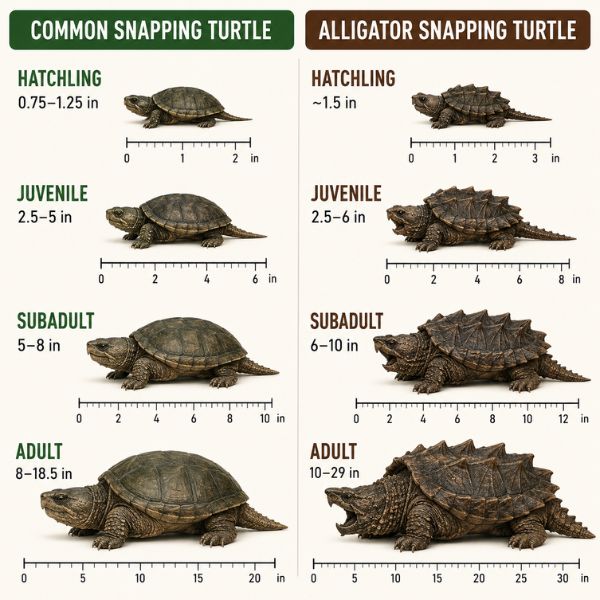
A snapping turtle under about 10 years old can often be placed into a rough age range by measuring its straight-line carapace length. A common snapping turtle near 10 inches long is often around young adult size, while an alligator snapping turtle near 10 to 12 inches long is often around 10 years old.
Adults are harder to age. A 12 inch common snapping turtle could be much older than a 12 inch alligator snapping turtle, and an old adult may grow so slowly that its size changes little for many years.
Use the charts below as estimates. Species, sex, diet, water temperature, local climate, and health all affect growth.
How accurate is snapping turtle age by size?
Snapping turtle age by size is most useful during early growth. It becomes less reliable after maturity because adult turtles keep growing slowly through life.
| Turtle stage | How useful size is | What to do |
|---|---|---|
| Hatchling | Useful | Use hatchling size, shell features, and season. |
| 1 to 5 years | Most useful | Measure shell length and compare with the species chart. |
| 6 to 10 years | Moderately useful | Use shell length, weight, species, and growth history. |
| Adult | Low precision | Use size only as a broad clue. |
| Old adult | Very low precision | Use known history or a reptile vet assessment when age matters. |
Researchers use growth models, mark-recapture data, scute lines, bone growth marks, and other methods to estimate age. Even those methods become less precise in older turtles.
Identify the species before using the chart
Common snapping turtles and alligator snapping turtles are not the same size as adults. You need to identify the species before using any age chart.
| Feature | Common snapping turtle | Alligator snapping turtle |
|---|---|---|
| Scientific name | Chelydra serpentina | Macrochelys temminckii and related Macrochelys species |
| Adult shell | Smoother in older adults | Heavy shell with three raised ridges |
| Head | Large, but less massive | Very large head with a hooked beak |
| Adult size | Often 8 to 18 inches straight-line carapace length | Large males can reach more than 20 inches |
| Best chart below | Common snapping turtle chart | Alligator snapping turtle chart |

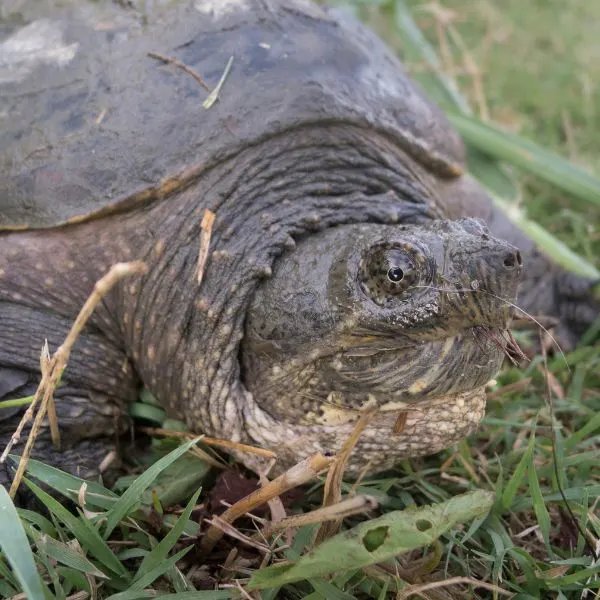
Not sure which species you found? Open our snapping turtle identification guide before using the charts.
How to measure shell length
Measure the carapace, which is the top shell. Use straight-line carapace length, often shortened to SCL in research papers.
- Place the turtle on a secure, flat surface only if it can be done safely.
- Measure from the front edge of the top shell to the back edge.
- Keep the ruler straight.
- Do not follow the curve of the shell.
- Record the length in inches and centimeters.
- Do not put your hands near the front half of a snapping turtle.
If the turtle is wild, injured, defensive, or in the road, do not handle it just to measure it. Take a photo from a safe distance and contact a local wildlife rehabilitator if it needs help.

Common snapping turtle age by size chart
Common snapping turtles grow quickly when young, then slow down as they approach maturity. These ranges are practical estimates for straight-line carapace length.
| Estimated age | Carapace length | What it usually means |
|---|---|---|
| Hatchling | 0.75 to 1.25 in (1.9 to 3.2 cm) | Newly hatched or very young |
| 1 year | 2.5 to 5 in (6.4 to 12.7 cm) | Fast juvenile growth |
| 2 years | 4 to 6.5 in (10.2 to 16.5 cm) | Still growing quickly |
| 3 to 5 years | 5 to 8 in (12.7 to 20.3 cm) | Juvenile to subadult range |
| 6 to 10 years | 7 to 10.5 in (17.8 to 26.7 cm) | Approaching young adult size in many regions |
| Adult | 8 to 18.5 in (20.3 to 47 cm) | Age is hard to estimate from size alone |
A large common snapping turtle is not automatically ancient. It may be a fast-growing adult from a warm region, a well-fed captive animal, or a male that continues growing larger than many females.
For a broader growth comparison across turtle species, see our how fast turtles grow guide.
Alligator snapping turtle age by size chart
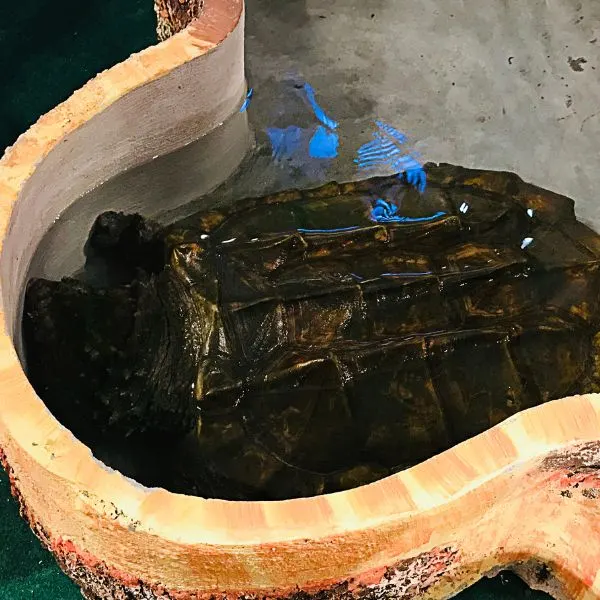
Alligator snapping turtles can grow much larger than common snapping turtles. A 12 inch alligator snapping turtle is not the same age estimate as a 12 inch common snapping turtle.

| Estimated age | Carapace length | What it usually means |
|---|---|---|
| Hatchling | About 1.5 in (3.8 cm) | Newly hatched or very young |
| 1 year | 2.5 to 4 in (6.4 to 10.2 cm) | Early juvenile growth |
| 2 years | 5 to 6 in (12.7 to 15.2 cm) | Juvenile growth stage |
| 3 years | 6 to 8 in (15.2 to 20.3 cm) | Large juvenile or subadult |
| 5 years | 8 to 10 in (20.3 to 25.4 cm) | Subadult range |
| 10 years | 10 to 12 in (25.4 to 30.5 cm) | Young adult range in many cases |
| 10 to 20 years | 12 to 16 in (30.5 to 40.6 cm) | Maturing or mature animal |
| Older adult | 16 to 29 in (40.6 to 73.7 cm) | Age cannot be estimated closely from size alone |
Alligator snapping turtles may not reach sexual maturity until roughly 11 to 21 years. Adult males can become much larger than females.
Snapping turtle weight by age
Weight can support a size estimate, but it is less reliable than shell length. A turtle can be underweight, overweight, gravid, dehydrated, or simply built differently from another turtle of the same age.


| Turtle | Size or age clue | Typical weight note |
|---|---|---|
| Common snapping turtle hatchling | Under 1.25 in shell length | Very light, usually weighed in grams |
| Common snapping turtle adult | Often 8 to 18.5 in shell length | Often 10 to 35 lb, with exceptional adults heavier |
| Alligator snapping turtle around 10 years | Often 10 to 12 in shell length | Often 10 to 35 lb |
| Alligator snapping turtle mature female | Can reach up to about 22 in shell length | Can reach up to about 62 lb |
| Alligator snapping turtle large male | Can reach up to about 29 in shell length | Can reach up to about 249 lb |
Do not try to weigh a large snapping turtle by hand unless you are trained and have safe equipment. A frightened snapping turtle can bite, scratch, fall, or injure itself.
Can you count shell rings to age a snapping turtle?

You can sometimes use shell rings as a rough clue in young turtles, but they are not the same as tree rings. Shell rings can form during growth changes, feeding changes, seasonal changes, injury, illness, or uneven living conditions.
Ring counting becomes less useful as the turtle gets older. Rings crowd together, wear down, and become harder to separate. On an adult snapping turtle, shell rings should be treated as a minimum estimate at best.
Why snapping turtle growth rates vary
Two snapping turtles of the same size may not be the same age. Growth depends on the turtle’s species, sex, origin, diet, water temperature, health, and habitat.
- Species Alligator snapping turtles can become much larger than common snapping turtles.
- Sex Adult males often grow larger than adult females.
- Climate Snapping turtles in warmer areas may have longer growing seasons.
- Diet Too much food in captivity can cause fast growth and poor condition.
- Health Illness, parasites, shell problems, and poor setup can slow growth.
- Habitat Water quality, food availability, basking access, and local ecology all matter.
For captive turtles, steady growth and good body condition are more important than matching a chart exactly. Review our turtle tank setup guide and turtle tank size calculator when planning enclosure space.
What to do if you found a wild snapping turtle

Do not take a wild snapping turtle home to estimate its age. In many places, native turtles are protected by state or provincial rules. Wild turtles also do best in their home range.
If a snapping turtle is crossing a road and it is safe for you to help, move it in the same direction it was already traveling. Do not pick it up by the tail. A car mat, shovel, or sturdy container can help you guide a large snapping turtle without putting your hands near its head.
Snapping turtles have long necks, strong jaws, and sharp claws. Keep your hands away from the front half of the turtle.
When to see a vet or wildlife rehabilitator
For a captive snapping turtle, contact a reptile vet if you need a more informed age estimate or if growth seems abnormal. A vet can assess shell condition, body condition, diet, setup, and overall health.
For a wild snapping turtle, call a licensed wildlife rehabilitator, animal control office, or local wildlife agency if the turtle is injured, bleeding, cracked, hit by a vehicle, tangled in fishing line, weak, unable to move normally, or in immediate danger.
- Do not attempt home treatment for a cracked shell.
- Do not keep a wild snapping turtle as a pet.
- Do not release a captive turtle into the wild.
- Do not handle a large snapper by the tail.
- Do not put your hands near the head or front half of the shell.
For health warning signs, see our guides to turtle first aid, shell rot, turtle respiratory infections, and turtle stress signs.
Related AllTurtles guides
- Types of Snapping Turtles
- How to Identify a Snapping Turtle
- What Do Snapping Turtles Eat?
- How Fast Do Turtles Grow?
- Snapping Turtle Enclosure Setup
- Turtle Tank Size Calculator
- Turtle Species Finder
Frequently asked questions
Can you tell a snapping turtle’s age by size?
You can estimate a snapping turtle’s age by size when it is young, but you cannot get an exact age from shell length alone. Size becomes less reliable after maturity because growth slows a lot.
How old is a 12 inch common snapping turtle?
A 12 inch common snapping turtle is usually an adult or near adult. It could be much older than 10 years, especially in a northern population where growth is slower.
How old is a 12 inch alligator snapping turtle?
A 12 inch alligator snapping turtle is often around young adult size and may be roughly 10 years old or older. The estimate depends on sex, origin, diet, temperature, and health.
How big is a baby snapping turtle?
A common snapping turtle hatchling is often about 0.75 to 1.25 inches in carapace length. An alligator snapping turtle hatchling is often closer to about 1.5 inches.
Can you count shell rings to age a snapping turtle?
Shell rings can offer a rough clue in young turtles, but they are not exact yearly rings. In adults, rings become crowded, worn, and unreliable.
How big is a 100 year old snapping turtle?
There is no single size for a 100 year old snapping turtle. A very old common snapping turtle may be large, but an alligator snapping turtle can become much larger. Without known history or expert assessment, age is still an estimate.
How fast do snapping turtles grow?
Snapping turtles grow fastest as hatchlings and juveniles. Growth slows as they approach maturity, then continues slowly through adulthood.
Should I take a wild snapping turtle home to measure it?
No. Do not take a wild snapping turtle home to measure it or estimate its age. Take a photo from a safe distance and contact a local wildlife agency or rehabilitator if the turtle is injured or in danger.
Sources and further reading
- Herpetological Conservation and Biology, estimates of somatic growth rates of common snapping turtles in Texas
- St. Cloud State University, age determination of common snapping turtles in west central Minnesota
- U.S. Fish and Wildlife Service, alligator snapping turtle profile
- North Carolina Wildlife Resources Commission, common snapping turtle profile
- Canada COSEWIC, snapping turtle assessment and status report
- U.S. Fish and Wildlife Service, tips for helping a turtle cross the road
- Tufts Wildlife Clinic, what to do if you found a snapping turtle
Final thoughts
Snapping turtle age by size works best as a rough estimate for young turtles. Measure straight-line carapace length, confirm the species, and compare the turtle with the right chart.
Once a snapping turtle is mature, size becomes a weak age clue. At that point, known history, species, sex, condition, and expert assessment matter more than shell length alone.
Steve Fleischman
Sunday 19th of May 2024
Very informative good job. I've had lots of snappers over The years A lot of car hits and rehab. Lost one to a 22 shot